Sunday, April 18, 2010

"Y" is for Yummy Wine Cocktails


Picnics are simply fun. But add a wine cocktail and you’ve turned a picnic into a celebration. Wine cocktails are a refreshing and tasty choice for spring and summer entertaining. They're simply yummy! The best part about this style of beverage is that you can use any brand of inexpensive wine.

When you’re creating wine cocktails, you may want to think of new ones that combine wine with fresh juices, liquors, pure alcohols and garnishes. O, you may want to reinvent an oldie.

Like food and wine, wine cocktails taste best when balanced in flavor. Too much acidity from added juices, too much bitterness or too much sweetness from liqueurs can alter the entire experience of a wine cocktail.

It’s fun to look for new and/or obscure ingredients for your wine cocktails, as well. Wine cocktails can include ingredients, such as lemongrass, maraschino liqueur and truffles. In fact, one of the most popular and newest wine cocktails in downtown Toronto is the Icewine Martini graced with a real, frozen Vidal grape from Niagara. Fresh mint leaves, slices of lemons and limes and sliced strawberries add color to these cocktails, making them pleasing to the eye.

‘Sangria’ is no doubt the most well known wine cocktail. Made in a pitcher, Sangria recipes are countless. However, a boozy version calls for five cups of red wine, five cups of orange juice, one and a half cups of Triple Sec, one cup of sweet and sour mix, one cup of Grenadine, one cup of brandy and two cups of lemon-lime soda. Triple sec adds strong orange flavour to this beverage, while Grenadine is a non-alcoholic syrup made from pomegranates that adds a bright color and zesty fruit flavour. Sangria is like an alcoholic tropical fruit bunch.

Along with Sangria, there are a variety of wine cocktails that you can serve this summer for barbecue dining and for entertaining. White port can be used in the making of ‘Scotti’s Apple Juice.’ To make this beverage, place crushed ice in a glass. Add an ounce of white port and an ounce of Drambuie and fill the remainder of the glass with apple juice, adding a dash of bitters at the end. Drambuie, made from a blend of scotch whiskies, gives this cocktail its alcoholic zing.

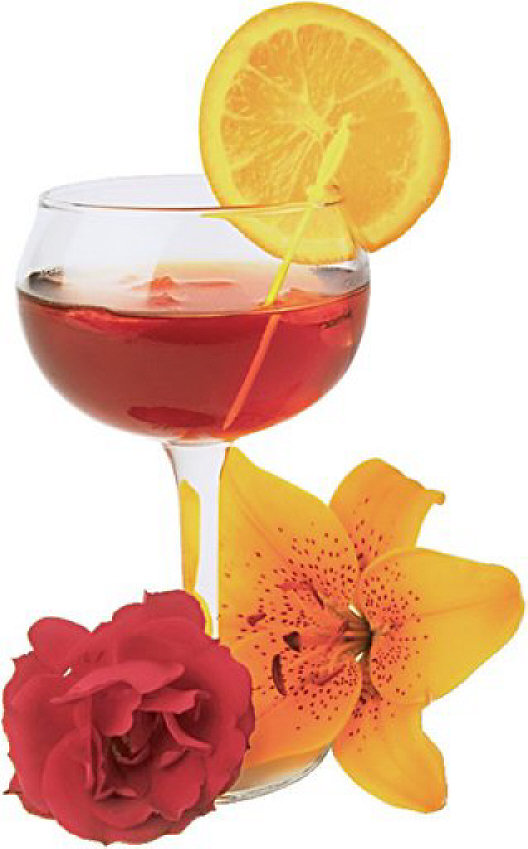
The ‘Cardinal’ combines red wine with an ounce of Crème de Cassis over ice and decorated with a slice of orange. Crème de Casis is a sweet, black currant-flavoured liqueur that complements the subtle acidity in full-bodied red wines.

The ‘California Julip’ is made with one and a half ounces of brandy, a quarter ounce of strawberry liqueur, a tablespoon of simple syrup (a mixture of sugar and water), brut sparkling wine and mint leaves. To make this drink, place a few mint leaves and the liqueur and syrup into the bottom of a glass. Using the back of a spoon, crush the leaves into the liquid. Place crushed ice in the glass. Add the brandy and fill the glass with sparkling wine. Garnish with mint sprigs.
I once asked my husband, “If I was a glass of wine, what wine would I be?” He immediately replied with “Champagne.” His reasoning, he told me, is that I’m always justifying a reason to celebrate. I crack open a bottle of bubbly if I’ve failed or succeeded, happy or sad. I prefer to think of myself as a complex, vintage Champagne. He argues that I’m an easy-going bubbly.

Wine cocktails made from sparkling wine are festive, refreshing and pleasing to the palate, not to mention a less expensive alternative to table wine for patio dining. And while these specialty drinks are called ‘Champagne’ cocktails, it’s best to use inexpensive sparkling wines, as well. These cocktails can also be made with soda water for the designated driver. Just add a little sugar to the soda water to sweeten the mix.

For wine aficionados who do not believe in mixing the ‘purity’ of wine with other liquids, such as fruit juices, pure alcohols and liqueurs, I have but one comment, “Lighten up!”

Here are a few Champagne cocktail ideas:

Classic Champagne Cocktail:
Champagne cocktail is the easiest to make. Pour sparkling wine (one with some sweetness) into each flute glass. Add 2 tablespoons of brandy and add a dash of bitters. A slice of lemon to each glass adds some flare.
· Colio Wines Viva Spumante (CSPC # 184390) $6.75
(Available at Colio Boutiques)
· Barclay’s Brandy (CSPC 6528) $12.75
· Alpenbitter (CSPC 212688/100 mL), $3.95

La Vie En Rosé:
This cocktail is also easy to make. Place four sugar cubes in the bottom of flute glasses. Pour one tablespoon of rosewater over the sugar cube. Let the cube soak up the liquid. Pour rosé sparkling wine into each glass.
· Freixenet Cordon Negro Brut (CSPC # 88591), $13.95
Rose water available at health food shops and some pharmacies

‘Death in the Afternoon’
This drink combines an ounce of absinthe and five ounces of sparkling wine, served in a champagne flute glass.
· Pastis Janot (CSPC # 701045) $19.95
· Freixenet Cordon Negro Brut (CSPC # 88591), $13.95

Bellini
This wine cocktails calls for an ounce of fresh peach puree and five ounces of sparkling wine.
· Freixenet Cordon Negro Brut (CSPC # 88591), $13.95
· 3 peaches, peeled and pureed

Flirtini
This is a highly alcoholic cocktail, calling for two pieces if fresh pineapple, half an ounce of cointreau, half an ounce of vodka, one ounce of pineapple juice and three ounces of sparkling wine.
· Cointreau SA (CSPC # 10322) $15.95
· Alberta Pure Vodka (CSPC # 1503) $11.70
· Freixenet Cordon Negro Brut (CSPC # 88591), $13.95

Thursday, April 8, 2010

"X" is for eXceptional Beer Marinade to Pair with Wine


Summer may be around the corner, but barbecue season is in full swing!

This past weekend my husband and I headed to my mom and dad’s house for a barbecue. My brother Bret and his family joined us.

Bret is as proficient with the barbecue as I am with my oven. As my dad puts it, “That boy can barbecue!” So, when dining at mom and dad’s home, Bret is always designated grill master.

Bret also brought with him a tub of rib eye steaks that he said had been marinating for a few hours in his refrigerator. I asked him about the marinade, and he told me that it was made from beer. Bret is as proficient with using beer in his cooking, as I am, wine.

In fact, I sat and watched him barbecue the steaks, hoping to pick up a few tips. Barbecuing appears to be an effortless affair for Bret. He holds a can of Canadian beer in one hand, and with the other, swings the tongs back and forth and up and down as though he is conducting a symphony.

At one point Bret jerked his arm forward, spraying beer from the can over the steaks. They sizzled. Smoke bellowed from the grill. I asked him if he had added more beer to flavour and tenderize the flesh.

Bret replied, “No. I’m putting out the flames.”

As a wine lover, I rarely use beer in my cooking, unless making a batter for deep fried fish or shrimp. I was curious as to how the taste of beer in the grilled steaks would taste with the flavours of red wine.

The steaks were delicious -- tender and juicy and highly flavourful.

The beer marinade obviously tenderized the meat while adding the taste sensation of bitterness to the steaks. Hops are the primary source of bitterness in beer. Red wine also possesses bitterness that derives from tannin. So the beer marinade and red wine harmonized in taste sensations.

This marinade also possesses flavour sensations that complements red wine, as well.
Bret’s beer marinade is a great match for big, red wines with weight and structure.

Paxton Jones Block 2005 Shiraz, McLaren Vale, Australia, (CSPC # 149914), $26.95 is a good choice. This is an exceptional Shiraz, the aromas swirling with ripe black berries and black peppercorns. The full-bodied palate offers flavours of raisins and leather, supported by excellent structure, medium tannin and a black pepper corn finish. This wine will certainly complement steaks done in Bret's marinade.

Paxton Jones Block is a member of ‘1% For the Planet Organization (www.onepercentfortheplanet.com). This organization’s mission is to build and support an alliance of businesses financially committed to creating a healthy planet. All members donate 1% of their profits to environmental groups around the globe each year. If you choose wines not only for their taste, but also for their social consciousness, you may want to explore other wineries committed to this same mission. Other wineries that belong to this organization in California include Sterling Vineyards, Spottswoode Winery, Shypoke Vineyard, Paradigm Winery, Oakville Ranch Vineyards, Hess Collection Winery, Grassi Wine Company and Ceritas Wines. Odisseia Wines in Portugal, Paxton Wines in Australia, Constant Jomini in Switzerland and Dosnon Champagne in France also belong to ‘!% For the Planet.’

The 14.5 percent alcohol gives Paxton Jones Block Shiraz much viscosity, making it ideal for heavier proteins like steak.

Here is the recipe:

Bret’s Beer Marinade

For Four Rib Eye Steaks

Three quarters cup of Canadian beer
One cup of Kraft Signature Roasted Garlic and Fine Herb Dressing
One package of Club House La Grille Seasoning Mesquite Marinade
Four rib eye steaks

In a large glass baking dish combine all ingredients. Whisk together. Set steaks in dish. Cover with plastic wrap. Set in refrigerator for about four hours, turning steaks over at beginning of second hour. When ready to grill, remove steaks from marinade. Throw out remaining marinade. Grill steaks to desired doneness.

Friday, March 26, 2010

"W" is for Wine and Wellington


I tried beef Wellington for the first time at age 16 at Inn on the Park in North York, Ontario. My first boyfriend and his family invited me to join them for dinner. This was the first sophisticated restaurant I had ever attended and it certainly left a great impression on me. My boyfriend assured me by whispering in my ear, "You can order whatever you like." I decided to order the same dish as my boyfriend's father, as I was enamored by his enthusiasm for a menu item called beef Wellington. Well, that evening I fell in love with the boy, his family, beef Wellington and fine dining.

It is believed that the Duke of Wellington, who won the Battle of Waterloo in 1815, was a finicky eater, yet happen to like one particular dish -- beef wrapped in puff pastry. So, this dish was named after him. Another story says this dish supposedly resembled his highly polished Wellington boot, and therefore acquired the name this way.

Whatever the true story might be, beef Wellington has remained a decadent and popular dish since this time.

This is a dish I've struggled with and have yet to master. The reason is my possessing an unwillingness to remember to use a meat thermometer.

Classic beef Wellington uses filet of beef tenderloin covered with pate (often liver or foie gras) and duxelles (mixture of mushrooms, onions, shallots and herbs), wrapped in puff pastry.

One version uses a Madeira sauce. Due to the richness and sweetness, this sauce requires, as a wine partner, a full-bodied red wine with forward fruit flavours and soft bitterness. Too much tannin (bitterness and astringency) will clash with the sweetness in the sauce. Try Merlot or Shiraz from a warm climate like Australia.

You might also choose to pair this dish with a dense, off-dry rose or even a small glass of tawny Port.

Forgo the Madeira sauce and partner classic beef Wellington (with or without a red wine sauce) alongside an austere red wine of choice, such as Cabernet Sauvignon, Cabernet Franc, Tempranillio, Amarone, etc.

There are many Wellingtons one can make using vegetables, fish, seafood, chicken, duck, pork, veal, venison, buffalo and even elk. I've recently discovered elk and absolutely adore it.


When making a classic rendition I use puff pastry. When making mock Wellington I like to use Pillsbury’s croissant dough, available in the refrigerator section at supermarkets. The croissant dough is easy to work, reliable and delicious and makes for outstanding individual, mock Wellingtons of every flavour. Just be sure to par cook heavier flesh like pork, chicken, venison or elk before wrapping it in the pastry.

I enjoy creating mock versions, such as salmon, chicken with pesto Wellington, steak with blue cheese and others.

Salmon Wellington seasoned with fresh herbs, such as dill or chives, tastes wonderful with pinot noir or red Burgundy. Salmon has enough fattiness to stand up to a light, fruit red.

Chicken with pesto Wellington is fatty, thus requiring a white wine with lots of fattiness, such as a barrel fermented and aged white like fume blanc or chardonnay. Fume blanc is sauvignon blanc that has been fermented and aged in oak barrels. Or look for a white from a warm climate with higher alcohol (14%). Alcohol adds viscosity to wine -- thickness in weight and texture. This occurs on the palate as fatty or creaminess.

Steak with blue cheese Wellington certainly requires a red wine with austere tannins, such as cabernet sauvignon.

You could also create pork Wellington with honey mustard, as well. The sweetness in the honey mustard needs a white wine with a hint of sweetness to match. Try off dry riesling or off dry gewürztraminer.

In fact, any sauce that you like with a particular flesh will work within the croissant pastry, as well. The choices are endless. Thai versions could include a coconut curry based sauce that can be matched to an off dry white wine, like riesling. Chicken Wellington with an Asian slant could include soy sauce with garlic and ginger or even a spicy plum sauce. Match the spicy plum sauce version to an off dry rose.

Saturday, March 20, 2010

"V" is for Vegetarian Appetizers


When entertaining I always suggest you begin with lighter dishes and move to heavier ones. Nowadays people are apt to enjoy vegetarian dishes in an attempt to cut back on animal fat. Meat can also be expensive, especially if you're incorporating it into many dishes throughout a meal.

I enjoy preparing an array of vegetarian appetizers. You are sure to please most guests and keep costs relatively low. It's also pleasurable to buy fresh vegetables at the local farmer's market, thus adding a seasonal approach and a level of quality and sophistication to the evening.

About a week ago I attended a fund raising, women-only event for one of my best friends, Terri Catlin. The profits from the evening were to fund her upcoming trip to the WOMEN'S INTERNATIONAL FILM & ARTS FESTIVAL in Miami where Terri's short film would be celebrated. The Dirty Truth is about a 1940s detective duo and how they discover that their new case may be more than they bargained for. When a domestic dispute turns out to be a matter of global proportions, Vic & Vera find themselves out of their league.

Back to vegetarian appetizers...

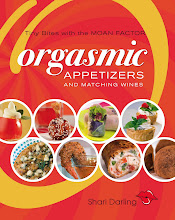
We chose four appetizers from my latest cookbook entitled Orgasmic Appetizers and Matching Wines -- Tiny Bites with the MOAN FACTOR.

We paired one wine style each with four appetizers. However, when entertaining, the key is to do the opposite -- choose three to five appetizers that partner with one wine.

Dining became with a sheep's milk feta dip incorporating olive oil, fresh oregano, black olives and artichokes. The tangy and bitter taste sensations in this dip called for a bone dry (brut) sparkling wine offering similar characteristics.
This dip is very easy to prepare. Lay out 2 pieces of tin foil in a "cross" formation. Drizzle the tin foil with quality olive oil. Add a handfull of chopped black olives (from a jar), artichoke hearts (from a can) and about a half cup of fresh oregano. Pull a large piece of sheep's milk feta from its way and lay it on top of the other ingredients. Wrap the cheese tightly in the tin foil and refrigerate for a couple of hours, allowing the flavours to meld.

About 45 minutes before guests arrive, place the tin foiled cheese in the over at 350 F. Upon guests arriving, open a bottle of brut sparkling wine or Champagne. Pull the cheese from the over. Open the tin foil and convert the cheese into a bowl. I like to slice a French baguette and fry the slices in oil in a fry pan. Serve the fried bread with the feta dip.

We also enjoyed sweet potato and curried latkes with a dollop of apple sauce. Another easy and inexpensive and tasty appetizer. The sweetness from the sweet potato and apple sauce and heat and spice from the curry demand a white wine with sweetness to match. The key is to ensure that the wine is sweeter than the potato and apple. An off dry Riesling with a sugar code of 2 will serve as ideal.

Our farmer's market features a mushroom vendor who supplies the most fabulous variety of fungi! The great thing about mushrooms is that they are high in the fifth taste sensation of umami. This makes them compatible with every style of red wine.

Wild mushroom and three cheese bruschetta complemented its accompanying red wine, an Ontario Shiraz.

We also enjoyed a Shitake Mushroom and Cashew Pate with an Ontario Merlot Reserve.

Spring is on the horizon and there are many Ontario grown fruits and vegetables available at this time of year, such as apricots, beets, carrots, mushrooms, onions, cabbage, etc.

All of these ingredients can be highlighted in appetizers. How about substituting the apple sauce for spicy apricot chutney on the sweet potato latkes? Or prepare a curried carrot and apple soup served in small portions inside cappuccino cups? Caramelized onions can be the centre piece of flat bread topped with brie or blue cheese and paired with Pinot Noir.

When considering ideas for appetizers think fresh and local vegetables. By doing so you can feature your meat in the entree -- perhaps Roasted Rack of Lamb with Spring Succotash and Wilted Spinach. Be sure to pair this lamb dish with a South African Cabernet Sauvignon.

Saturday, March 13, 2010

"U" is for Unbelievable Mushrooms


Recently, owner, friend and chef extraordinaire from Rare restaurant on Brock Street in Peterborough, handed me a bright red-orange and wonderfully lumpy ingredient.

“A gift,” he said. His eyes twinkled with excitement. You would have thought he was Jack T. Colton, soldier of fortune in the 1984 movie Romancing the Stone, handing me the treasure. “A lobster mushroom,” he said.

I had sampled lobster mushrooms in dishes before, but I had not actually seen one whole until this moment. The mushroom’s colour resembled the red-orange shell of a cooked lobster. I felt giddy, knowing Brad had just given me a hard-to-obtain culinary gem.

When I put the mushroom up to my nose to smell it, one question immediately came to mind. “What wine would harmonize with the damp woody smell of this British Columbian delight?” I had a plethora of wines to consider.

Fresh lobster mushrooms are a rare find in Ontario. I have chef friends who have only tasted dried versions of this exotic Canadian west coast fungi. In fact, this is not a mushroom at all, but rather a parasitic ascomycete that grows on mushrooms, turning them lobster red.

Grown in areas, such as Vancouver Island, lobster mushrooms are firm, but softly textured with a distinctive woody smell and taste. Some say the mushroom smells like sweet cooked lobster. I don’t think so. I think its woody character makes it an ideal ingredient for a wine offering earthy aromas and flavours.

That evening I cut the mushroom in half, deciding to incorporate its flesh into 2 meals. Using fresh tomatoes, garlic, fresh basil, extra virgin olive oil and balsamic vinegar I made bruschetta on toasted Italian bread for my husband and parents.

This appetizer had an overall tangy taste from the tomatoes and balsamic, calling for a chilled pinot noir. We sipped Pelee Island Winery 2007 pinot noir, VQA, (CSPC # 135939), $12.45. What I love most about Pelee Island wines is that they are predictably good from year to year. It’s difficult to get a pinot noir at this price, let alone one with loads of flavour. At $12.45 per bottle, this is the ideal price to spend on a wine that you’re serving with an appetizer. The wine is light bodied with good tangy notes with earthy flavours that gently drew the palate’s attention to the woody flavour of the lobster mushrooms. This bruschetta can be made with shitake mushrooms, as well.

While the mushroom provided earthy notes to the bruschetta, I did feel that it had competed with the big flavour of ripe tomatoes. So, I decided to feature the second half of my fungi in a pasta dish the following evening. Brad had suggested I keep the pasta dish simple, sautéing the thin slices of mushroom in quality olive oil with fresh minced garlic, fresh herbs, and salt and pepper. I made this pasta sauce according to his directions, tossing it with a bowl of hot spaghetti. I sprinkled the dish with freshly grated parmesan. The mushroom flavours shone through this time, adding exotic flair to such a simple meal. Any Spanish red, with an earthy quality, will work with this dish. You can use any wild mushrooms in this dish, as well.

My husband and I sipped a glass of Tapena 2008 tempranillo, (CSPC 72942), $13.95. This Spanish red is also a culinary gem, medium bodied with earthy, chocolate and coffee tones on the nose and palate. It is a delightful quaffer at a reasonable price.

Tempranillo is one of the most popular grape varieties grown and vinified in Spain. This particular Tapena red is bold enough to work with beef, lamb, duck and game meats, and of course, lobster mushrooms.

Tapeña wines are generally fruit forward. You may recognize this winery byone of its most famous wines called “Freixenet.”

Sunday, March 7, 2010

"T" is for Taking the Time for the Song and Dance


This is part three in the series called Romancing the Grape.

In many restaurants the mark-up on wine can be hefty. You pay not only for the wine, but for the sommelier or server's song and dance - that is the art of opening and presenting the wine to you, the host, and your guests.

After ordering from the list, the server will return to your table, presenting the bottle of wine to you. He/she will display the label. Be sure to read the name of the winery, the style (Bordeaux) or grape variety (Cabernet Sauvignon) and most definitely the vintage date. The same wine can vary in quality and price from year to year.

While attending sommelier training at George Brown College (I need not mention the year), my teacher, Jacques Marie, taught us that a professional server or sommelier will blend into the wood work. Today too many servers are looking to be the centre of attention during your dining experience. A trained, professional sommelier or server will create a quiet, seamless and professional experience for the host and his/her guests.

Quietness is key. This includes the sommelier quietly pulling the cork from the bottle rather than popping it out. The sommelier uses the cork screw to pull the cork about three quarters out of the bottle neck. Wrapping his/her hand around the cork, the sommelier will then gently wiggle the remainder of the cork from the bottle, thus ensuring complete silence in opening the wine.

Again quietness is key. At no time should the server or sommelier interupt or listen in on the table conversations.

The sommelier may then wipe the rim of the bottle if some cork has been desposited here.

After opening the bottle, the sommelier will then put the cork in front of you, the host, who ordered the wine. The bottle may be placed on your table for stability or the sommelier may hold the bottle in the air. In either case, the sommelier stands to the right of host.

You may have noticed some people smelling the cork. This is to apparently determine if the wine is ‘off.’

Smelling the cork tells you very little about what's in the bottle. A musty or moldy smell from the cork could mislead you, as well. It is common for the cork to develop a little mold just under the capsule. It will most likely not affect the wine in the bottle.

Look at the brand name on the cork and make sure it matches the brand on the label. If the names are different this could be an indication that the wine is homemade or a fake.

For some it is advantageous to feel the cork. If it is completely dry, this may be a sign that the bottle has been stored upright, rather on its side, thereby allowing air inside the bottle and causing the wine to oxidize – to age before its time. Young wines, however, may have dry corks because they have just been bottled. If the cork is gummy, this may be a good indication that the wine has oxidized.

The sommelier or server will then pour an ounce into the host’s, glass. The host’s job is to swirl the wine, smell it and taste it. If you’re unsure as to what to smell, just concern yourself with the taste. If the wine tastes pleasant, nod and let the sommelier then fill your guests’ glasses first; yours last.

If the wine’s taste reminds you of cooked fruit – the kind you put into a pie – then the wine may very well be oxidized. If the cork is gummy and the wine taste liked cooked fruit, ask for another bottle of wine. Cork taint affects approximately about three percent of all wines. So, your chances of getting one are slim.

If ready for a second bottle of wine to be brought to the table, make sure the server does not put new wine into your used glasses. Politely put your hand over the bowl and request a new glass for your second wine. If you’re switching from white to red wine, it’s also appropriate to ask for a clean glass.

If you like the wine, be sure to tell the restaurant owner. This is the only way he/she will know how to successfully build a wine cellar.

Thursday, February 25, 2010

"S" is for Selecting Wines from the Wine List


Part Two of Romancing the Grape -- The Wine List

The restaurant wine list can be intimidating. Restaurateurs will tell you that some of their finest vintages never sell because the names of wines can be difficult to pronounce. Gewurztraminer, for example, is one of those wines. Pronounced ‘ge-wurz-tra-meener’, this white is full bodied, is produced both dry and off-dry and offers wonderful aromas and flavours of flowers, spice, and tropical fruit, depending on the terroir in which the grapes are grown.

While it may be ideal to partner to spicy Thai dishesa and East Indian cuisine, Gewurztraminer is often avoided. Many customers would rather refrain from mispronouncing the name and therefore looking bad to their fellow companions than in trying something new.

Don't be shy to ask the wait-person or sommelier how to pronounce the wine. Their job is to both educate you and create your culinary experience.

Add to this that every restaurant has its own individualistic approach to creating the wine list. Lists can be organized and simple, dividing by country, grape variety, style, price and/or region. Other lists look like a novel, listing pages upon pages of vintages.

So how does the average, novice wine lover read the wine list? The answer is by process of elimination and the art of experimentation.

First, are you a foodie who sips wine or a wino who likes to eat? Foodies choose the dish and then find a wine to match. Winos choose the wine and then order a dish accordingly.

What is your budget? I like to hunt for unique and quality wines at reasonable prices. Given that most wines are marked up by 100%, I refrain from drinking these excessively expensive vintage while dining out.

Next, eliminate the house wine. They are often inexpensive, non descript red and white wines, purchased by price rather than quality. They carry the highest mark-up, as well.

No doubt the easiet way to choose is to match a regional wine to a regional food and to stay within your budget.

And then there are those foodies and winos who operate by their emotions above budget and palate. They choose wine according to their mood.

So, there are no hard and fast rules that can be applied to choosing wine from the list for each kind of wine lover.

Most people choose wine to partner to the entree.

If you feel like drinking white wine, then choose a style that will match your dish. All wines fall into various styles. Within each style you'll find an array of grape varieties or 'varietal' wines. The style will dictate the wine's most predominant taste sensations, such as tangy and fruit or fruity and sweet. The taste sensations are key when pairing wine to food.

The terrior in which the grape is grown will determine the wine's flavours on the nose and palate. While two whites may be light and crisp, one can have citrus flavours in the aromas while another might be more floral. Flavours are less important in creating harmony on the palate between the wine and food.

Pair your entree to a wine's taste sensations.

Crisp dry whites (Sauvignon Blanc) work with tangy dishes highlighting ingredients like goat cheese or feta or salty dishes, such as caviar or smoked salmon.

Off dry white wines offset heat and spice and complement foods slightly sweet, such as those featuring sweet potato.

Full-bodied, oaky whites (Chardonnay) harmonize with fatty foods like cream-based or butter-based sauces over pasta.

If you enjoy red wine, then there are three basic styles from which to choose -- light fruity reds like Pinot Noir), reds with forward fruit (like Shiraz) or austere reds(Cabernet Sauvignon).

Light, fruity reds marry well with oily fish like salmon and tuna, as well as chicken or fresh tomato based sauces over pasta.

If you prefer gentle heat and spice choose a red wine with forward fruit as the tannin tends to be soft, thereby not interfering with the heat and spice. This style also complements roasted tomato sauces and can complement chicken, beef or duck.

Heavier reds work best with red meats, salty cured meats like prosciutto and salty, hard cheese like Romano or Parmesan.

Consider experimenting. Ask the server to recommend a wine. Take a chance. Before ordering, request samples of a few wines. This will give you the opportunity to experiment and try the wines before spending your hard earned dollars.
Buy wine by the bottle. If dining with two or more guests, it’s cheaper to order by the bottle than by the glass.

If you’re interested in expanding your knowledge, ask the server if you can try a half glass of two wines (listed at the same price) rather than ordering a full glass of wine.

If you like a certain grape variety, such as chardonnay or cabernet sauvignon, try ones from different wine regions and/or countries. An Ontario chardonnay, considered a wine produced in a cool climatic region, for example, has a completely different taste profile than a chardonnay produced in a warm climate, such as South Africa. Ontario chardonnays are lighter in style with a good backbone of acidity. The acidity cleans the palate between bites, thus making them good food wine.

A South African chardonnay will be heavier in style, more suited for heavier dishes, such as cream based pasta. The more sunshine hours over a growing season and the hotter the temperatures of a region, the greater the sugar level in the grapes. During fermentation sugar is converted to alcohol and carbon dioxide. The carbon dioxide dissapates, leaving alchol in the wine. So warm climates tend to produce wine with higher alcohol. Alcohol creates viscosity or thickness on the palate. It is experienced as mouth feel. Wines with high alcohol can have a heavy or creamy texture, thus making them suitable for fattier dishes.

Don’t shy away from trying new wines because the grape variety is hard to pronounce. Ask the server to pronounce the name for you and have him/her explain the qualities of the wine.

If ordering two glasses of wine, rather than a bottle, try different ones. Save a little wine from your first glass to compare against the new wine in your second glass. This simple act, alone, will aid in expanding your love and understanding of the fermented grape.

There's only one guideline I like to stress and that is to keep an open mind and try a different wine every time you dine out, exploring wine regions from around the world. This is the only way to finally discover the wines that fit into your personal taste profile.